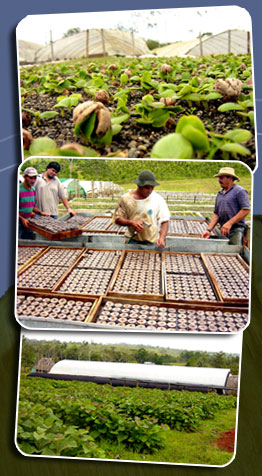

PRODUCTION SYSTEM
Production takes place in a Jiffy pellet pot. This product is made from moss, which gives nutrients to the plant, is completely organic (biodegradable), and a 6-week production cycle is obtained.
The pellet pot provides a series of benefits to the plants, as opposed to stakes or planting in plastic bags. These benefits are as follows:
- Greater radical development, provoked by auto pruning, since this promotes a greater secondary root development (up to 300% greater).
- Greater initial growth at plantation time.
- Lesser field mortality, since no transplant is made (the whole pellet pot is sown).
- When sown, the plant is 8-10 centimeters high, which guarantees a lesser stress rate.
- Lesser moving when taking the material to the field than regarding the plastic bag.
- Smaller surface (infrastructure) needed to realize the production.
- Maintenance labors (weed removal, fertilizing, and hilling) and production cycle are reduced.
INSTALLATIONS
The plant nursery has two types of settlements:
- Closed greenhouse: used in the quality improvement projects
of the planting material.
It’s a 1000 square meters installation with a metallic structure and isolating material that allows the control of environmental conditions – temperature and relative humidity. This structure is used for the superior-quality material reproduction, which is then transferred to the open greenhouses. - Open greenhouse: used in the development of the planting material.
Teak plants are produced in tunnel-shaped modules that are 5 meters wide and 50 meters long, with a maximum 36 000 plant capacity each. The greenhouse has 10 modules, which can be translated to a maximum production capacity of 60 000 plants per week or 240 000 plants per month. (216 hectares / month).